
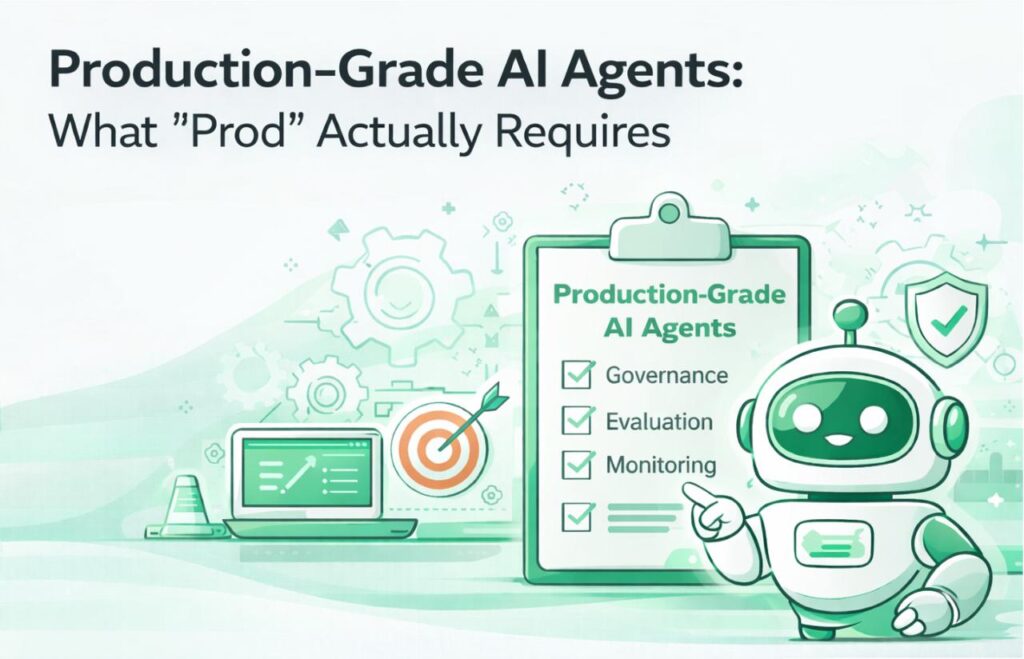
“Production-grade” isn’t a buzzword. It’s a standard: the agent behaves predictably, operates safely inside real systems, and remains reliable after launch.
Most agent projects fail in production for reasons that have nothing to do with prompts: missing controls, unmeasured quality, weak retrieval, and no operational ownership.
What is an AI agent in a business context?
An AI agent is a workflow that can reason, decide, and act across tools—CRM, helpdesk, ERP, email, databases—under defined guardrails. In production, agents are not “smart chat.” They are operational systems.
The 7 requirements of production-grade AI agents
1) Clear scope and ownership
- Defined workflow boundary (what the agent can and cannot do)
- Named owner (accountable for quality, changes, incidents)
- Change process (how updates are approved and released)
Rule: If nobody owns it, it will fail silently.
2) Safe tool access (least privilege)
- Allowlisted actions only (read/write boundaries)
- Role-based access control (RBAC)
- Approval steps for sensitive actions
- Audit logs for every tool call
Rule: The agent should never have “god mode” access.
3) Grounded knowledge (RAG) for factual work
- Retrieval over approved sources
- Permission-aware access
- Traceability to sources (citations or evidence links)
- Freshness strategy (indexing, updates, ownership)
Rule: If the agent can’t point to its source, trust will collapse.
Related: Evaluation gates for AI agents
4) Evaluation gates (quality is measured, not assumed)
Production agents must be tested like software: offline test sets, scenario coverage, regression checks, and pass/fail thresholds.
Rule: If you can’t measure quality, you can’t scale adoption.
5) Monitoring (quality, cost, latency, failures)
- Success rate by workflow step
- Latency and timeout rates
- Cost per run and cost spikes
- Escalation/approval frequency
- “Uncertain” patterns (when the agent should stop)
Rule: If you don’t monitor it, you don’t operate it.
Related: AI agent monitoring essentials
6) Reliability engineering (fallbacks and safe failure)
Agents should degrade safely: retries with limits, deterministic fallbacks for critical steps, human handoff when confidence is low, and incident-ready traces.
Rule: A safe failure is better than a confident mistake.
7) Adoption design (humans stay in the loop where it matters)
Adoption improves when agents fit existing workflows, have clear approval points, and provide rationale and traceability. Teams adopt what they can trust.
Rule: Adoption is a product requirement, not a training problem.